
Most HR and benefits leaders in business services know burnout is a problem in their sector. Fewer feel confident their benefits package is built to address it. The standard toolkit, an EAP plus maybe a wellness stipend, was designed for a different pattern of need.
This guide helps benefits leaders and people teams audit what they have, see where the gaps are, and think clearly about what a more complete support model looks like. The challenge of burnout in the business services sector is well established. The question is whether the benefits strategy is actually built to respond to it.
Why standard benefit packages fall short
The most common mental health benefit is the EAP, and in business services environments it is frequently underused. The reasons are structural.
First, stigma. In cultures where demonstrating resilience and capability is a professional norm, self-identifying as someone who needs mental health support can feel risky. Employees who are coping, however barely, often wait until they cannot before reaching out.
Second, friction. EAPs typically require scheduling an appointment, sometimes with a wait, with a provider whose availability may not align with a consultant’s calendar. For someone managing back-to-back client commitments, the bar to access can feel high.
Third, scope mismatch. EAPs are episodic care models designed for acute need. They are not designed for the chronic, low-grade stress that characterizes much of the burnout risk in business services. An employee who is not in crisis but is steadily depleting does not fit neatly into an EAP model.
The result is a coverage gap. The employees most at risk are often the least likely to use the resource nominally available to them.
Getting more from your EAP
Getting more from your EAP starts with understanding what a strong EAP looks like. Not all EAPs are equivalent. Quality varies in provider network breadth, session limits, response times, and the range of issues covered. Teams that have not recently audited their EAP against current workforce need may find the gap larger than expected.
Beyond the product itself, use is heavily influenced by how the EAP is communicated. Benefits mentioned once during open enrollment and then remain absent from organizational communication tend not to get used. Regular, normalized mentions of EAP access in manager training, team communications, and people operations workflows can meaningfully increase uptake.
The difference between apps and EAPs matters here. These are complementary tools, not competing ones. EAPs address acute and clinical needs. Digital mental health tools can support the broader population before clinical intervention is warranted. Understanding the distinction helps teams frame both appropriately, rather than positioning one as a substitute for the other.
What a complete mental health benefits strategy looks like
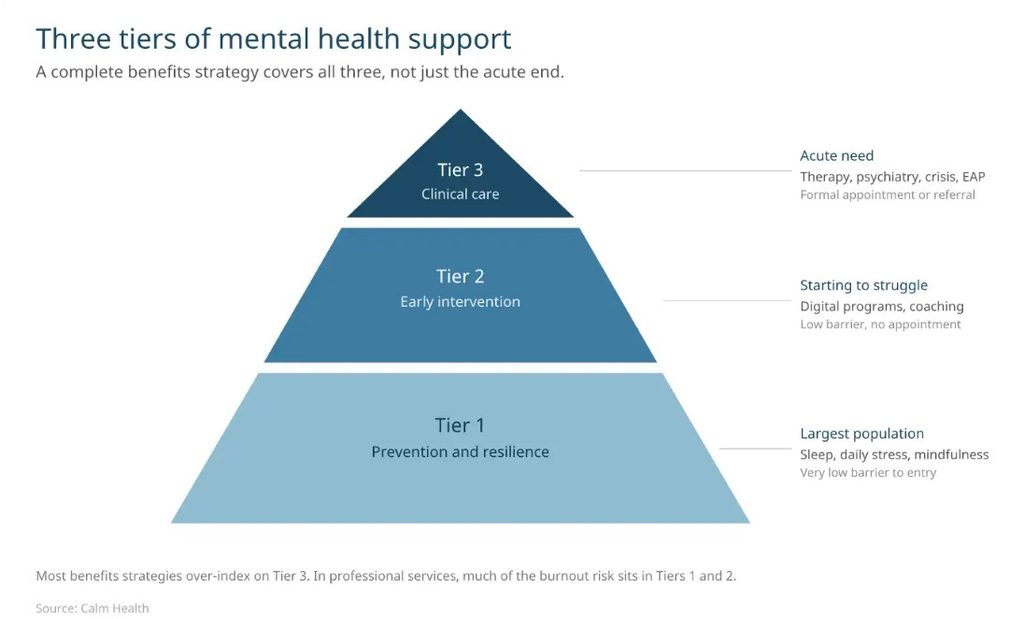
A well-designed strategy addresses multiple tiers of need, not just the acute end. This is not a new idea. It adapts the prevention continuum that has organized public health practice for three decades, which sorts support into universal (everyone), selective and indicated (those at elevated risk or early symptoms), and treatment (those with a diagnosed condition). That continuum was formalized by the Institute of Medicine in 1994 and reaffirmed by the National Research Council and IOM in Preventing Mental, Emotional, and Behavioral Disorders Among Young People.
The WHO Guidelines on Mental Health at Work, published jointly with the ILO in 2022, apply that same escalating logic directly to employers. Their recommendations move from organizational and universal interventions, to support for workers experiencing emotional distress, to clinical care and workplace accommodations for workers with mental health conditions. The U.S. Surgeon General’s Framework for Workplace Mental Health and Well-Being makes a related case, that workplace conditions themselves are a lever for prevention rather than only a backdrop for treatment.
The underlying principle is matching the intensity of support to the level of need. A 2024 umbrella review of meta-analyses found that stepped care models, which do exactly this, can improve access without sacrificing outcomes.
Calm’s 5 pillars of mental health support at scale builds on the same foundation. For practical benefits design, three tiers matter most.
| Tier 1: Prevention and resilience | Tier 2: Early intervention | Tier 3: Clinical care | |
|---|---|---|---|
| Who it serves | The largest share of the workforce, managing but under sustained demand | Employees starting to struggle, not in acute need | Employees with acute need |
| Typical support | Sleep, daily stress management, mindfulness | Digital programs, coaching, low-barrier options | Therapy, psychiatry, crisis support, EAP |
| Barrier to entry | Very low | Low, no formal appointment | Formal appointment or referral |
Tiers adapted from the IOM prevention continuum and the WHO/ILO Guidelines on Mental Health at Work (2022).
Most benefits strategies are heavily weighted toward Tier 3 while leaving Tiers 1 and 2 underserved. In business services, where much of the burnout risk sits in those first two tiers, that is a meaningful misalignment.
Consider a common scenario. A mid-size firm offers an EAP, but utilization sits well below the share of the workforce experiencing stress. Reported utilization rates vary widely by program and measurement method, with some studies finding usage in the single digits. The benefit is not failing; it is simply built for a smaller slice of need than the workforce actually has. Adding accessible Tier 1 and Tier 2 support may help reach the larger population before stress becomes acute.
Tools built for the way this sector works
When evaluating mental health tools for business services employees, a few attributes matter more than they might elsewhere.
Accessibility. A resource that requires a 45-minute session does not fit between client calls. Self-directed tools that provide value in five or 10 minutes are more likely to be used consistently.
Low barrier to entry. Employees should not need to self-identify as struggling to use the tool. A mental health app presented as a daily support resource, not a crisis intervention, may reduce stigma and support adoption across the full workforce, not just those who are already struggling.
Population-level data. Teams in business services operate in data-rich environments. Tools that provide aggregate engagement data, trend reporting, and use patterns give leaders population-level visibility that individual EAP reports do not. This can support the case for continued investment and help identify team or department trends before they surface in turnover.
How modern mental health tools help business services teams reflects how this category has matured. What was once a consumer wellness product has become a serious workforce benefit. Calm Health, for example, is designed to complement an EAP by giving employees and members another accessible resource for mental health education, self-guided support, and employer benefits navigation. It is not a replacement for an EAP, clinical care, or crisis services.
Making the business case internally
In business services, investment decisions tend to be evaluated through a financial lens. Leaders who want to expand or upgrade mental health benefits should be ready to make the case in terms that resonate: retention, productivity, healthcare cost trends, and competitive positioning for talent.
Retention is usually the strongest argument. The cost of replacing a high-performing consultant or analyst is significant. Gallup estimates that replacing an employee can cost from one-half to twice their annual salary, depending on the role.
Mental health benefits also weigh on retention intention, particularly among younger employees: in one 2023 Securian Financial survey, 65% of Gen Z and 60% of Millennial workers said it is very important for their organization to provide mental wellness benefits. In a separate 2023 Deloitte survey, a majority of Gen Z said they would consider leaving for better mental health support.
Healthcare use is a secondary argument worth quantifying. Employees experiencing chronic stress or burnout tend to have higher healthcare costs over time. A 2025 analysis in the American Journal of Preventive Medicine estimated the annual cost of employee burnout at roughly $4,000 to $21,000 per employee, depending on role. Prevention that may reduce that use has a return that can be modeled where data is available.
Building a wellness program that holds up means connecting program design to organizational outcomes, not just employee experience. Leaders who can show the financial logic alongside the human logic tend to get further, faster.
Frequently Asked Questions
Usually a mix of stigma, scheduling friction, and scope mismatch. EAPs are built for acute, episodic need, so employees experiencing chronic low-grade stress may not see them as the right fit.
No. Calm Health can complement an EAP by adding an accessible resource for mental health education, self-guided support, and employer benefits navigation. It does not replace EAPs, therapy, or crisis services.
Estimates vary by role. Gallup places the cost at roughly one-half to twice an employee’s annual salary.
Three: prevention and resilience, early intervention, and clinical care. This structure follows the prevention continuum used in public health and applied to workplaces in the WHO/ILO Guidelines on Mental Health at Work. Many strategies over-index on clinical care and under-serve the first two, where much of the burnout risk in business services sits.
Helpful reading
- Burnout in the Business Services Sector: What HR Teams Need to Know, the full picture
- How Business Services Leaders Can Help Prevent Burnout Before It Starts, structural prevention strategies
- How to recognize burnout in business services teams, spotting the signs
- 5 pillars for improving employee mental health at scale, a framework for benefits design
If you’re reviewing how your mental health benefits fit together, see how Calm Health can complement your existing EAP and benefits ecosystem.
A note on support: If you or someone on your team is in crisis or thinking about self-harm, contact local emergency services or a crisis line right away. In the US, you can call or text 988 to reach the Suicide and Crisis Lifeline.