Each year, the shift to Daylight Saving Time reminds us how important it is to get consistent, high-quality sleep—and how closely employee sleep quality is tied to day-to-day performance at work. Setting the clocks ahead by just an hour disrupts our circadian rhythms and sleep patterns, causing many of us to feel tired, stressed, irritable, less able to concentrate, and less productive. For HR and benefits leaders, even small disruptions can quickly show up as lower focus, more mistakes, and reduced capacity.
But studies show that many employees are struggling to get consistent, high-quality sleep on a regular basis, not just when the clocks change. A Calm survey found that 70% of US employees are having trouble falling asleep, and 70% are having trouble staying asleep, for example. The impact to employees and organizations is significant. This is one reason “sleep and productivity” is increasingly discussed as a core workplace well-being priority. When sleep becomes inconsistent, employees may still show up—but with less cognitive bandwidth for complex work, collaboration, and decision-making.
Insufficient sleep affects employee productivity and quality of work
Indeed, NSF data illuminates the impact of insufficient sleep on employee productivity and quality of work:
- Insufficient sleep negatively impacts the work productivity of 60% of Americans
- 69% of Americans report difficulty thinking clearly due to poor sleep
- 60% of fatigued employees have problems managing their workload and avoiding mistakes
The NSF has also found that 33% of adult workers have fallen asleep or become sleepy at work, and more than 10% have been late to work due to not sleeping well. These impacts can affect both safety-sensitive roles and knowledge work—especially when fatigue builds over time.
The high cost of employee fatigue
The cost of employee fatigue is high for their employers. The National Safety Council (NSC) estimates that reduced productivity resulting from poor employee sleep costs organizations from $1,200 to $3,100 per employee per year. An organization with 1,000 workers is estimated to incur an annual loss of $1 million due to employee fatigue: $776,000 from presenteeism and $272,000 from absenteeism. For benefits departments, this can also translate into increased demand for support across EAPs, mental health benefits, and chronic condition programs.
But lost productivity and missed work days aren’t the only cost impacts of insufficient sleep. Not getting enough quality sleep is also associated with a wide range of physical health challenges, including high blood pressure, insulin resistance, and higher risk of type 2 diabetes, which can have a negative impact on employer healthcare costs. In other words, improving employee sleep quality can support both performance goals and broader health outcomes.
Calm Health resources to help employees get better sleep
Experts recommend that adults get at least seven hours of quality sleep each night to reduce stress and anxiety, improve mood, and help them think clearly. To support them in that effort, Calm Health features three clinically based sleep programs developed by sleep experts.
Sleep Strategies to Win Restful Nights
Sleep Strategies to Win Restful Nights is an evidence-based clinical program on Calm Health that supports people struggling with insomnia. Over 8 sessions, the step-by-step guide offers a range of techniques and tools designed to help people reclaim their sleep. Listeners learn proven sleep methods grounded in sleep science and derived from techniques used in cognitive behavioral therapy for insomnia. (CBT-I is a structured, skills-based approach for insomnia.)
The program was developed by Aric Prather, PhD, a Professor in the Department of Psychiatry and Behavioral Sciences and director of the Behavioral Sleep Medicine Research Program at the University of California, San Francisco. Dr. Prather is also a licensed clinical psychologist who treats patients with sleep disorders, primarily insomnia, using cognitive behavioral therapy. He is the author of The Sleep Prescription: 7 Days to Unlocking Your Best Rest.
Easy Tips for Better Sleep
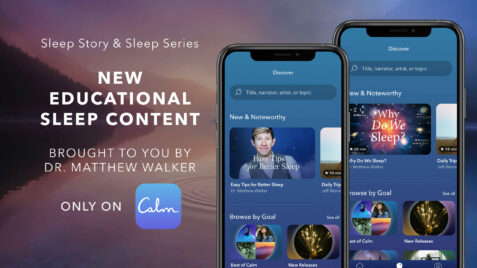
Easy Tips for Better Sleep is a five-part series by Dr. Matthew Walker that educates listeners about how sleep works and provides meaningful tips and tools to help them cultivate healthy habits for better sleep. Available on the Calm Health and Calm apps, episodes are just 4-5 minutes in length.
Dr. Walker is the bestselling author of Why We Sleep and professor of neuroscience and psychology at the University of California, Berkeley. He has dedicated his life’s work to examining how sleep works and affects every aspect of physical and mental well-being. His goal is to help as many people as possible receive the health and wellness benefits of sleep, which can include an improved ability to learn and to regulate hormones, and possibly a reduced risk of developing cancer, diabetes, and Alzheimer’s disease. He also wants to help listeners feel less stressed about sleep.
Better Sleep, a masterclass
In this clinically based series, Dr. Michael Breus, The Sleep Doctor, discusses sleep patterns and issues, health tips, and practical tools designed to help listeners sleep better. Michael Breus, PhD, is a clinical psychologist and sleep expert. He is a Diplomate of the American Board of Sleep Medicine and a Fellow of The American Academy of Sleep Medicine.
Calm Health Sleep Stories and Meditations
Calm Health features an extensive library of Sleep Stories and meditations designed to help adult brains shift into a more relaxed mode. These stories are purposefully gentle and atmospheric so that the mind can slowly drift off and fall asleep. A few genres are guided visualizations, soft-spoken narratives, mindfulness-infused storytelling, and classic literature with a twist.
7-Day Employee Sleep Challenge
Your employees also can use the 7-day employee sleep challenge by Dr. Shelby Harris, clinical psychologist, to find their sleep language and get tips for improving sleep quality. Dr. Harris is board certified in Behavioral Sleep Medicine (BSM) by the American Academy of Sleep Medicine. She treats a wide variety of sleep disorders using evidence-based non-pharmacological treatments.
How workplace wellness programs can support better sleep
If you’re evaluating workplace wellness programs, sleep support is a practical, high-demand benefit. A few employer-friendly ways to reinforce healthy sleep (without making medical claims) include:
- Normalize rest as part of performance: Encourage leaders to model boundaries and recovery time.
- Support consistent routines: Share simple sleep hygiene education (light, caffeine timing, wind-down habits).
National Sleep Awareness Month
March is National Sleep Awareness Month, a perfect time to evaluate your workforce well-being strategies and sharpen your focus on sleep. Helping your employees fall asleep faster and stay asleep can have a direct impact on their health and the health of your organization.