
Stressors are everywhere—at work, home, and in communities around the world. We all face the pressures of managing responsibilities, relationships, and change, whether an unexpected illness, loss of a job, expanding our family, or losing a loved one. As if that weren’t enough, we’re carrying the added weight of political turmoil, global instability, economic challenges, and an uncertain future.
It’s no wonder that US workers feel persistently strained, with 50% saying they experienced significant stress the previous day and 43% reporting worry, according to Gallup’s 2026 wellbeing survey.
Amid so much uncertainty and pressure, resilience is important for both individuals and organizations. Employees and leaders need the ability to adapt well in the face of adversity and change and continue to function in a healthy way.
But resilience can be a confusing concept now that it’s become a buzzword. To bring some clarity to the subject, clinical psychologists Lise Deguire, Psy.D., and Chris Mosunic, PhD, recently shared their expertise, debunking common myths about resilience and offering insights about its power and how to build it.
Here are five things about resilience that every employee and organization leader should know.
1. Resilience isn’t a superpower you’re born with. It’s something you can learn, practice, and hone.
When many of us think of resilience as a superpower used in moments of great trauma or crisis, like a life-threatening health problem or natural disaster, Deguire said. “But almost every day, there’s something that we’re going through that is a little stressful or difficult. And the mindset we bring to everyday issues can really change the quality of our life.” The same positive, scrappy mindset can be applied to problems big or small, she explained.
And contrary to popular belief, that mindset isn’t something you’re born with. “Resilience is a skill set,” said Mosunic. “It’s a set of achievable skills . . .you learn them, you stink at them at first, and you get better over time. That’s the way resilience works.”
2. Resilience doesn’t mean going it alone. Relationships are key.
A common misunderstanding about resilience is that you need to handle challenges on your own, without asking for help. The reality is quite the opposite, according to Mosunic: “Resilience is fostered by social connection with other people.”
Deguire emphasized the importance of social skills to a resilient mindset. “Social reciprocity, knowing how to smile, knowing how to help other people, accepting help. These social skills bring more love into our lives and help us when we have problems, because people are more likely to want to help us in return and open up opportunities for us. The love in our lives is what sustains us through hard times.”
In addition to social skills, Deguire names gratitude, optimism, active coping, love, and meaning-making as the core capabilities that make up a resilient mindset. She refers to these skills as the G‑O‑A‑L‑S + M‑M method.
3. Resilience requires gratitude, not toxic positivity.
Many people believe that to be resilient, you can’t talk about anything bad, just the good. But resilience is not toxic positivity, Mosunic explained. “It’s not positive thinking. It’s accurate thinking and getting really good at staying in the moment and being as accurate as you possibly can with your thinking.”
At the same time, it’s vital to practice gratitude, Deguire said. “Most of us spend most of our time thinking about the things we don’t have or the things we’re worried we’re not going to have . . . We’re not talking about toxic positivity here. What I’m talking about is developing the skills to turn your attention also to the things you have, the things that are going well.”
Resilience is critical for healthy workplaces. Here’s how to help your employees develop it.
Get the e-guide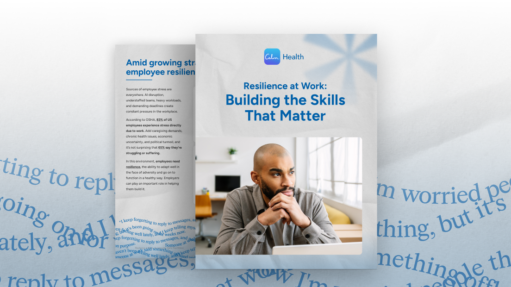
4. Resilience should be a top priority for every organization.
Resilience isn’t just a personal concern; organizations have a strong interest in helping employees build it, Mosunic argued. Without a resilient workforce, organizations are more likely to struggle with burnout and turnover. “The employees you want to keep the most, the ones working the hardest, are the most likely to burn out,” he said. “Resilience is the skill that’s going to help them and prevent them from burning out.”
Resilience is also critical for employee performance. When stress, anxiety, or depression go unaddressed, employees are less able to solve problems, adapt to change, and learn new skills. “So it’s an investment. The good ones, you don’t want them to leave. And all of your workforce, you want them to get better and be more efficient at what they’re doing. Resilience is the key to being able to have that in place.”
5. Resilience isn’t just possible; it’s likely.
Studies tracking people through adversity have found that resilience is not uncommon. In fact, most people eventually adapt and recover from difficult experiences, Deguire said.
That reality offers an important message of hope. “Resilience is possible,” Deguire said. “And I’m going to add to that: resilience is likely.” Even for people who feel they aren’t naturally resilient, the skills that support resilience can be learned and strengthened over time. Whether through mental health and wellness programs such as Calm Health, professional support, or intentional practice, people can develop the capabilities that help them navigate challenges and emerge stronger.
For more insights about resilience, including the importance of sleep, eating well, and staying optimistic, watch the on-demand webinar: Building Resilience During Challenging Times.