
The state of executive mental health in America presents a paradox: while most executives describe their mental and emotional health as “good,” deeper data reveals that it’s a wishful thinking self-portrait. Beneath a polished exterior, American executives are navigating heavy stress, insufficient rest, and a growing recognition that sleep and mental health are not secondary — they are central to performance.
At the same time, leaders are redefining resilience by embracing vulnerability, investing in wellness, and reaffirming that, even in the age of AI, human talent and innovation will continue to pioneer the future of work.
Together, these findings underscore both the challenges and opportunities facing today’s C-suite — and highlight the urgent need for organizations to support leaders as whole people.
In a recent executive survey conducted September 9-14, 2025, among an online sample of 253 C-suite executives using TrueDot.ai, the AI-accelerated research platform, three key findings emerged:
- American executives are often stressed, overwhelmed, and sleep-deprived, despite appearing composed on the outside.
- Executives view sleep and mental health as important KPIs for leaders.
- Human talent remains central to the future of business— even in the age of AI.
1. While outwardly composed, American executives are stressed, overwhelmed, and sleep-deprived
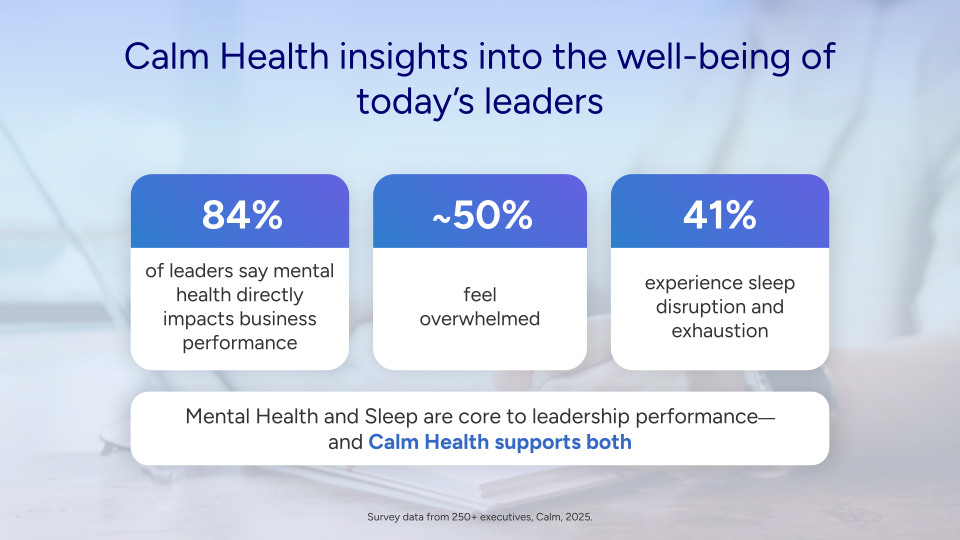
- While nearly nine in 10 executives (87%) report their mental/emotional health is “good” or better, almost half (48%) acknowledge feeling overwhelmed, and about a quarter (24%) report leadership stress showing up as anxiety or depression.
- 50% say they’ve considered stepping down from their leadership role, while nearly two-in-three have considered a career change and taking a sabbatical
- Only one in four reports their “mental battery” is fully charged.
- Asked to break down their work stress into “good” and “bad,” executives overall see two-thirds as positive stress:
- Executives embrace productive stress, estimating 67% of their pressure drives growth and innovation. A substantial majority (85%) sees “good stress” as fueling excellence.
- More than half of all respondents see “bad” stress emanating from insufficient resources and economic pressures, with about three in 10 citing being “always on,” poor work-life balance, and unclear priorities.
- Younger executives who are Gen Z or Millennials are more likely than older executives to single out resources, “Imposter syndrome,” and return-to-office pressures as sources of “bad” stress.
The toll of this leadership stress is manifesting in executives’ lives as sleep difficulties (41%), exhaustion (34%), and an inability to be mentally present (40%).
- 42% say they actively shield their teams from their stress.
- One in three executives think about changing careers at least monthly, and nearly one in four (23%) consider stepping down at least once a month. Among executives who see their work stress as “hard to manage”, majorities are actively considering these options.
Executives identify two unique leadership pressures as predominant stress drivers:
- Responsibility for others’ livelihoods (63%)
- A feeling of having “no off switch” (54%)
2. Executives view sleep and mental health as important KPIs for leaders
Executives increasingly see well-being not as a personal indulgence, but as a core leadership tool.
Getting good sleep: a performance edge
- 81% believe sleep is the most underutilized performance tool.
- 78% sleep less than the recommended seven hours per night; only 36% frequently or consistently feel rested.
- 42% now consider good sleep a competitive advantage, but more see it as either “necessary but hard to prioritize” (32%) or “something to be sacrificed” during periods of intensity (12%). Four in 10 would take a power nap if given 30 minutes to recharge, and three in four already use or are open to using sleep technology.
- Work-related stress is the dominant sleep disruptor — from not being able to turn off work thoughts (56%) to anxiety about the next day (28%) being the most prevalent causes of sleep disruption. Phone use in bed (25%) and family responsibilities (22%) are next in line.
- The consequences of poor sleep compound quickly. Sleep-deprived executives are significantly more likely to report being overwhelmed, more likely to report higher alcohol consumption, and more apt to get sick frequently.
Supporting mental health is a business imperative
- 84% agree that mental health directly impacts the bottom line.
- 67% cite either engagement (39%) or productivity (28%) as the most valuable reasons to support it.
- 71% believe mental health will be embedded in business practice within three years.
Executives themselves are adopting wellness practices
- Executives recharge their mental batteries with walking (70%), music (46%), and exercise (41%).
- Ways in which executives personally support their teams’ mental health include encouraging time off (55%), checking in regularly (51%), and modeling healthy boundaries (29%).
- Other avenues executives feel they can support their and their teams’ mental health include use of mindfulness apps (82%), therapy (72%), coaching (80%), and stress management training (77%).
- 60% believe that as leaders, they must model vulnerability.
3. Human talent remains at the center of the future of doing business— even in the age of AI adoption
Despite dystopian narratives about artificial intelligence replacing human work, executives emphasize a people-first future. Executives signal confidence that leadership, creativity, and judgment remain distinctly human strengths that will pioneer the future of AI adoption at work.
- 79% describe the human brain as the “original data center” — irreplaceable for innovation.
- While one-third (30%) of companies are not yet exploring AI, most are beginning to implement it.
- Only 13% fear AI will replace human workers.
- Most, 57% see AI and human talent as complementary, with 31% seeing “AI as a tool that frees humans for higher-value work” and another 25% who see AI as enhancing “human capabilities without replacing them.”
Methodological Note: Calm’s Executive Mental Health Study was conducted September 9-14, 2025, among an online sample of 253 C-suite executives using TrueDot.ai, the AI-accelerated research platform. Potential respondents were identified and sampled via LinkedIn and contacted via email and text to participate. No opinion data was inferred or modeled. The modeled MOE is +-5.3% for the full sample.